



Un regolatore elettronico di velocità (ESC) è un circuito elettronico che controlla la velocità e la direzione di un motore elettrico.An electronic speed controller (ESC) is an electronic circuit that controls the speed and direction of an electric motor.
Sia che l'ESC sia per un motore brushed o senza spazzole, l'ESC interpreta le informazioni di controllo. Non si tratta di un movimento meccanico come nel caso delle servounità, ma piuttosto di un modo che varia la velocità di commutazione di una rete di "transistor a effetto di campo", o più comunemente noti come FET. La rapida commutazione di questi transistor è ciò che fa sì che il motore stesso emetta il suo caratteristico sibilo acuto, particolarmente evidente a velocità più basse. Questi FET consentono anche un controllo della velocità del motore molto più fluido e preciso e in un modo molto più efficiente rispetto ai vecchi regolatori di velocità meccanici. Contiene una bobina resistiva e bracci mobili, che vedevamo in molti modelli, in particolare nel settore dei modellini di automobili, qualche anno fa. La maggior parte dei moderni ESC con e senza spazzole incorporano un "circuito eliminatore di batteria" (BEC) per regolare una tensione stabile per far funzionare il ricevitore e i servocomando, questo elimina la necessità di dover trasportare una batteria aggiuntiva nel modello. I BEC sono solitamente "Lineari" o "Modalità commutata".Whether the ESC is for a brushed motor or brushless the ESC interprets control information. This is not as in a mechanical motion as found in the case of servo units but rather in a way that varies the switching rate of a network of "Field-Effect Transistors", or more commonly known as FETs. The rapid switching of these transistors is what causes the motor itself to emit its characteristic high pitched whine, this is especially noticeable at lower speeds. These FETs also allow a much smoother and more precise speed control of the motor and in a far more efficient way than the older mechanical type of speed controllers.It contains a resistive coil and moving arms, which we used to see in a lot of models, notably in the model car sector, a few years ago. Most modern brushed and brushless ESC's incorporate a "Battery Eliminator Circuit" (BEC) to regulate a stable voltage to run the receiver and servo's, this removes the requirement to have to carry an extra battery in the model. The BEC's are usually either "Linear" or "Switched Mode".
- BEC lineariLinear BEC's
Un BEC lineare funziona riducendo la tensione dai 7,4 V-11,1 V che utilizziamo normalmente con i nostri pacchi LiPo ai 5 volt richiesti dal ricevitore. Maggiore è la tensione LiPo e maggiore è la potenza consumata dall'RX, maggiore è il calore generato quando la corrente scorre su questo resistore. Troppa corrente surriscalderà e danneggerà il controller elettronico della velocità o il BEC. Per non parlare dello spreco di molta elettricità, soprattutto con gli aerei elettrici più grandi.A linear BEC works by stepping the voltage down from the 7.4v-11.1v we normally use with our LiPo packs to the 5 volts required by the receiver.The higher the LiPo voltage and the more power the RX consumes, the more heat is generated as the current flows over this resistor. Too much current will overheat and damage your electronic speed controller or BEC. Not to mention it also wastes a lot of electricity, especially with larger electric airplanes.
- BEC scambiatiSwitched BEC's
I BEC commutati riducono efficacemente la tensione senza generare calore o sprecare elettricità accendendo e spegnendo rapidamente la tensione. Alcuni BEC commutati ti consentono anche di scegliere se il tuo ricevitore è fornito con 5v o 6v, a seconda di come e che tipo di aereo voli. In passato era noto che l'accensione e lo spegnimento della tensione causavano alcune interferenze con alcune apparecchiature radio, ma oggigiorno questo tipo di interferenza è stato quasi eliminato con la maggior parte dei moderni dispositivi a 2,4 GHz. Come regola generale, è meglio utilizzare un BEC commutato se la batteria LiPo ha quattro o più celle e dove sono richieste elevate esigenze di potenza. L'ESC in un senso più ampio è un controller PWM (Pulse Wide Modulation) per motori elettrici. Il ricevitore invia un segnale PWM a 50 Hz all'ESC con una variazione da 1 ms a 2 ms, a 1 ms il motore sarà fermo, a 1,5 ms il motore funzionerà a metà velocità e a 2 ms funzionerà a piena velocità; ovviamente, si ottiene un controllo della velocità uniforme tra questi numeri. ESC per spazzole I motori sono molto diversi dagli ESC per i motori brushless e non sono compatibili tra loro. È necessario utilizzare un ESC brushless con un motore brushless e un ESC con spazzole con un motore brushed. Sono abbastanza facili da identificare, poiché un ESC con spazzole ha 2 fili del motore e un ESC senza spazzole ha 3 fili del motore.Switched BECs effectively lower voltage without generating heat or wasting electricity by rapidly switching the voltage on and off. Some Switched BEC's also allow you to choose whether your receiver is supplied with 5v or 6v, depending on how and what type of aircraft you fly. This switching of the voltage on and off had been known to cause some interference in the past with some radio equipment but this type of interference has these days been just about eliminated with most modern 2.4GHz outfits. As a general rule of thumb, it's best to use a switched BEC if your liPo battery has four or more cells and where high power demands are required. ESC's in a broader sense is Pulse Width Modulation" (PWM) controllers for electric motors. Your receiver puts out a 50Hz PWM signal to the ESC with a variation from 1ms to 2ms, at 1ms the motor will be stationary, at 1.5ms the motor will be running at half speed, and at 2ms it will be running at full speed, you, of course, get a smooth speed control in between these numbers. ESC's for brushed motors are very different from ESC's for brushless motors and are not compatible with each other. You must use a brushless ESC with a brushless motor and a brushed ESC with a brushed motor. They are quite easy to identify, as a brushed ESC has 2 motor wires and a brushless ESC has 3 motor wires.
Controllo di un motore a spazzoleControlling A Brushed Motor

Come forse saprai, un motore brushed funziona più o meno meccanicamente finché viene applicata una tensione. Per controllare la velocità con cui il motore gira, l'ESC a spazzole accende e spegne semplicemente la tensione, questo viene fatto molto rapidamente e molte volte al secondo. Per aumentare la velocità del motore, l'ESC aumenta semplicemente il tempo in cui la tensione viene attivata e diminuisce il tempo in cui la tensione viene disattivata. Per rallentare il motore il processo è invertito. Il punto chiave per comprendere la differenza tra un ESC con spazzole e un ESC senza spazzole è che l'ESC con spazzole non si preoccupa della posizione dell'armatura del motore brushed, ecc., proprio come menzionato prima accende e spegne semplicemente la tensione.As you may know, a brushed motor more or less runs itself mechanically as long as a voltage is applied. To control how fast the motor spins the brushed ESC simply turns the voltage on and off, this is done very rapidly and many times a second. To increase the speed of the motor, the ESC simply increases the amount of time the voltage is turned on and decreases the amount of time that the voltage is turned off. To slow the motor down the process is reversed. The key point in understanding the difference between a brushed ESC and a brushless ESC is that the brushed ESC does not care about the position of the brushed motor armature etc, it just as mentioned before simply turns the voltage on and off.
Controllo di un motore brushlessControlling A Brushless Motor
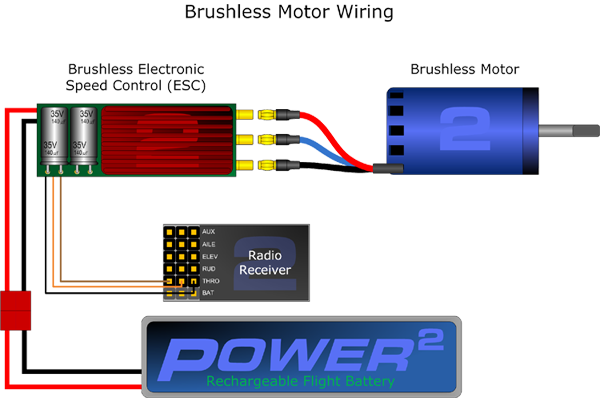
Poiché i motori brushless funzionano in modo completamente diverso, controllarli è un processo completamente diverso. Senza spazzole l'ESC non ha idea della posizione delle bobine/statore. È necessario un qualche tipo di feedback dal motore per determinare esattamente quando energizzare ciascun polo. Gli ESC senza spazzole creano fondamentalmente un'uscita di potenza CA trifase da una fonte di alimentazione CC per azionare il motore inviando una sequenza di segnali CA generati dai circuiti dell'ESC. È qui che ora entrano i 3 fili, solo 2 dei fili vengono energizzati dall'ESC in qualsiasi momento. Il polo che non viene energizzato in un istante specifico genererà una piccola quantità di tensione proporzionale alla velocità di rotazione del motore; questo è noto come "Forza elettromotrice posteriore" (EMF posteriore). Questa piccola tensione viene utilizzata dall'ESC per determinare la velocità e la direzione in cui il motore sta ruotando in un dato momento. Con queste informazioni, l'ESC sa come inviare energia agli elettromagneti per mantenere il motore in rotazione. Questo rilevamento della posizione e di ciò che sta facendo il motore può essere ottenuto anche utilizzando un sensore magnetico "effetto Hall" o un rilevatore "ottico", che si trova più comunemente negli ESC delle automodelli e i motori brushless In-Runner sono solitamente controllati con il "Back EMF". stile dei controllori.Because brushless motors work completely differently, controlling them is an entirely different process. Without brushes, the ESC has no idea of the position of the coils/stator. It needs some kind of feedback from the motor to determine exactly when to energize each pole. Brushless ESC's basically create a "3 phase AC power output from a DC power source to run the motor by sending a sequence of AC signals generated from the ESC's circuitry. This is where the 3 wires now come in, only 2 of the wires are energized by the ESC at any one time. The pole that is not energized at any specific instant will generate a small amount of voltage that is proportional to how fast the motor is spinning; this is known as "Back Electromotive Force" (Back EMF). This small voltage is used by the ESC to determine how fast and in what direction the motor is rotating at any given time. With this information, the ESC knows how to send power to the electromagnets to keep the motor turning. This sensing of the position and what the motor is doing can also be achieved by using a magnetic "Hall Effect" sensor or "Optical" detector, these are more commonly found with model car ESCs and In-Runner brushless motors. Outrunner motors are usually controlled with the "Back EMF" style of controllers.
I controllori di velocità programmabili da computer generalmente hanno opzioni specificate dall'utente che consentono di impostare limiti di interruzione di bassa tensione, temporizzazione, accelerazione, frenata e senso di rotazione e oggigiorno molto altro ancora. L'inversione della direzione del motore può essere ottenuta anche scambiando due qualsiasi dei tre cavi dall'ESC al motore.Computer-programmable speed controllers generally have user-specified options that allow setting low voltage cut-off limits, timing, acceleration, braking, and direction of rotation, and these days much more. Reversing the motor's direction may also be accomplished by switching any two of the three leads from the ESC to the motor.
Scelta di un regolatore di velocità elettronicoChoosing An Electronic Speed Controller
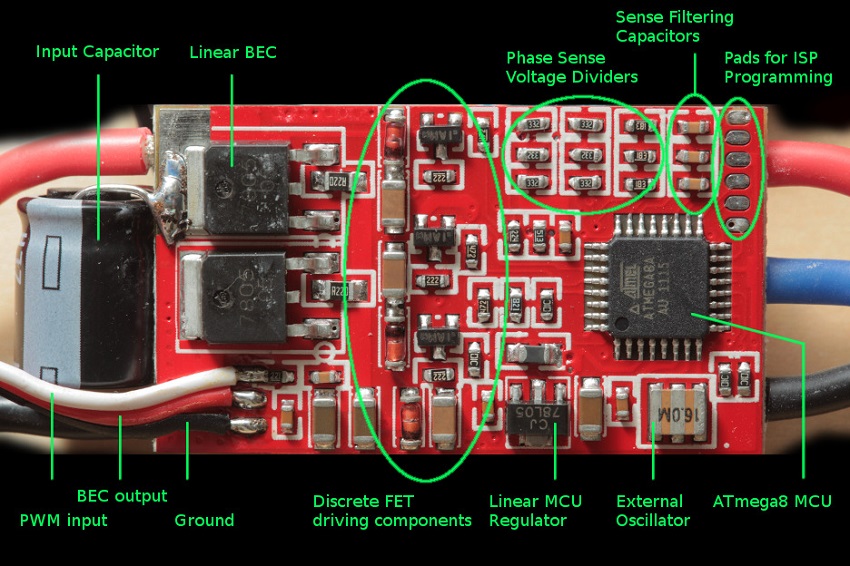
Gli ESC sono classificati per la corrente massima che possono gestire. Quanto più attuale è un ESC, tanto più costoso e pesante sarà. Scegli un controller di velocità elettronico con una potenza leggermente superiore a quella che la tua combinazione motore/elica tirerà a tutto gas. Troppa corrente danneggerà molto rapidamente un regolatore elettronico di velocità! D'altra parte, un ESC troppo grande è un peso morto che influenzerà negativamente le prestazioni del tuo aereo, è più costoso e semplicemente non è necessario. Le batterie LiPo verranno danneggiate in modo permanente se la tensione di una cella scende al di sotto di 3,0 volt. Per questo motivo, le batterie LiPo richiedono un regolatore elettronico di velocità con un interruttore di bassa tensione (LVC). L'LVC interromperà l'alimentazione al motore quando la tensione raggiunge 3,2 V, o qualunque sia il valore di interruzione preprogrammato. Dovrai anche scegliere un ESC in grado di gestire la tensione del pacco batteria che intendi utilizzare, la tensione nominale per ciascun ESC è chiaramente indicata nelle specifiche.ESC's are rated for the maximum current they can handle. The more current an ESC is rated for the more expensive and heavier it will be. Choose an electronic speed controller that is rated for slightly more than what your motor/propeller combination will pull at full throttle. Too much current will damage an electronic speed controller very quickly! On the other hand, too big an ESC is dead weight that will adversely affect the performance of your airplane, is more expensive, and is just not necessary. LiPo batteries will be permanently damaged if the voltage of any cell drops below 3.0 volts. For this reason, LiPo batteries require an electronic speed controller with a low voltage cutoff (LVC). The LVC will cut the power to the motor when the voltage reaches 3.2V, or whatever you pre-program the cut-off to be. You will also need to choose an ESC that can handle the voltage of the battery pack you plan to use, the voltage rating for each ESC is clearly stated in the specifications.
RiepilogoSummary
Questo è solo un breve approfondimento, non troppo tecnico, su come funzionano i regolatori elettronici di velocità. Spero che ti sia piaciuta la lettura e che ora tu abbia un po' più di comprensione di come funzionano effettivamente.his just a short, not too technical insight on how Electronic Speed Controllers work, I hope you have enjoyed reading it and now have a little more understanding of how they actually work.


