

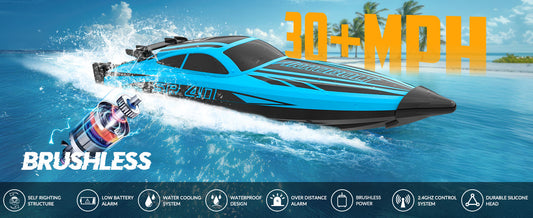
This article explains what RC boats are. It covers the basics like what they are and how they work. We also talk about if they can go in saltwater and how fast they can be. You will learn about six top RC boats to buy. RC boats are fun toys that you control from far away. They come in many types and speeds. Some work in salt water if you care for them well. Speeds range from 10 to over 50 miles per hour. We keep things simple so anyone can understand. This guide helps beginners pick the right boat for lakes or pools.
Table of Contents
- What is the Remote Control Boat?
- RC Boat Hull Designs and Configurations
- Could It Be Used in Saltwater?
- Step-by-Step Saltwater Maintenance Guide
- How Fast Do RC Boats Go?
- Power Systems: Brushed vs. Brushless Explained
- How Do RC Boats Work?
- How Water Cooling Systems Protect Your Boat
- The Best 6 RC Boats to Buy
- Frequently Asked Questions (FAQ)
What is the Remote Control Boat?
A remote control boat, or RC boat, is a small model boat that you control from a distance. You use a handheld device to make it move.
These boats are like toys but for hobby fun. They can race on water or just cruise around. RC boats come in many sizes and styles. Some look like real ships. Others are fast speed boats.
People of all ages enjoy them. You can use them in pools, lakes, or ponds. They are powered by batteries or gas. Most are electric now. This makes them easy to use.
RC Boat Hull Designs and Configurations
To really understand remote control boats, you should know that they are not all shaped the same way. The shape of the hull determines how the boat cuts through the water, how fast it can turn, and how stable it is in rough waves. Let us explore the four most common hull designs used in the hobby today.
1. Mono Hulls (Deep-V Hulls)
This is the classic boat shape. It has a V-shaped bottom that cuts through chop and waves like a knife. Deep-V boats are highly versatile and stable. They are the best choice for running in open lakes where waves can get rough. Most beginner models use this design because it is stable and predictable in turns. If you want an all-weather boat that can handle windy days, a deep-V hull is the way to go.
2. Catamarans
A catamaran hull has two separate pontoons with a wide air tunnel between them. When the boat reaches high speeds, air gets trapped in this tunnel, lifting the boat out of the water. This is called "riding on a cushion of air." Catamarans have very little surface area touching the water, which reduces drag and allows for extreme top-end speeds. They are excellent for racing on calm water but can blow over if they catch a strong gust of wind.
3. Hydroplanes
Hydroplanes are designed for flat-out straight-line speed. They have a wide front section with steps (called sponsons) and a narrow rear. At speed, only the tips of the sponsons and the propeller touch the water. They look like they are flying just above the water surface. They turn by carving hard with a metal turn fin on one side. They are highly specialized and require calm water to run safely.
4. Flat Bottoms and Utility Hulls
These are slower, realistic model ships like tugboats, cargo ships, or scale fishing boats. They have flat bottoms and sit deep in the water. They are not built for speed, but rather for realistic scale detail and long battery life. They are great for quiet ponds where you want to relax and practice steering maneuvers.
Could It Be Used in Saltwater?
Yes, some RC boats can be used in saltwater. But not all are made for it. Salt water can harm the boat if you do not clean it well. It causes rust on metal parts.
Always rinse the boat with fresh water after use. Dry it too. Some boats have special parts that fight rust. Check the maker's guide.
If it says okay for salt, then go ahead. But many say use only in fresh water. This keeps the boat working longer. Take care, and your boat will last.
Step-by-Step Saltwater Maintenance Guide
If you do decide to run your boat in saltwater, you must be prepared to do heavy maintenance immediately after your run. Saltwater is highly corrosive. If you leave even a small drop of saltwater inside the hull or on the propeller shaft, it will begin to rust the metal parts overnight. Within a few days, your motor bearings could seize up, rendering the boat useless. Follow this simple guide to protect your watercraft after a saltwater session:
- Flush with Fresh Water: As soon as you finish your run, take the boat to a sink or hose. Rinse the entire exterior of the hull with clean, fresh tap water. If your boat has a water-cooling system, connect a small syringe of fresh water to the inlet tube and flush clean water through the cooling lines to wash out any salt deposits inside the motor jacket.
- Clean the Interior: Open the hatch and carefully inspect the inside. If any saltwater leaked in, dry it completely using a microfiber cloth. Spray a light coat of water-displacing spray (such as WD-40 or a marine-grade corrosion inhibitor) on the motor, ESC connections, and rudder linkage to displace moisture and prevent rust.
- Remove and Grease the Flex Shaft: Loosen the coupler holding the flex shaft to the motor. Pull the shaft out of the stuffing tube. Wipe it clean of any old grease and salt residue. Apply a liberal coat of high-quality marine grease along the entire length of the cable, then slide it back in. This grease prevents water from traveling up the tube and protects the cable from rusting.
- Air Dry: Leave the hatch open in a warm, dry room for at least twenty-four hours before storing the boat away. This allows any trapped condensation to evaporate fully.
How Fast Do RC Boats Go?
RC boats can go from slow to very fast. Beginner boats go about 10 to 25 miles per hour. Fast ones reach 30 to 50 miles per hour or more.
Some top models hit over 60 miles per hour. Speed depends on the motor and battery. Brushless motors are faster.
Big batteries help too. In races, boats zoom across water. But fast speeds need calm water. Wind and waves slow them down. Pick a speed that fits your skill. Start slow if you are new.
Power Systems: Brushed vs. Brushless Explained
To understand why some boats go much faster than others, we need to look at the motor systems inside. RC boats use either brushed or brushless motor configurations. Let us examine how they differ in cost, performance, and longevity.
Brushed motors are the older technology. They use physical carbon brushes to transfer electrical current to the spinning center of the motor. This physical contact creates friction and heat. Brushed motors are cheap to make, which is why you find them in boats under one hundred dollars. However, they are limited in speed (usually topping out at 20 miles per hour) and the brushes wear out over time. They are excellent for small pools or for kids who do not need extreme speeds.
Brushless motors use electronic speed controllers (ESCs) to spin the motor using magnets. Because there are no physical brushes touching the spinning shaft, there is almost no friction. This makes brushless motors highly efficient. They run cooler, draw less power from your battery, and can spin at much higher speeds. A brushless boat can easily hit speeds of 30 to 50 miles per hour. While they cost more upfront, they require zero motor maintenance and last much longer, making them the best option for serious hobbyists.
The battery you choose also plays a major role in your top speed. Running a brushless boat on a two-cell (2S) LiPo battery might get you 25 miles per hour, but swapping in a three-cell (3S) battery can boost that speed to 40 miles per hour. Always make sure your motor and ESC are rated to handle the higher voltage before upgrading your battery, as too much power can burn out your electronics.
How Do RC Boats Work?
RC boats work with radio signals. You hold a transmitter. It sends commands to the boat. The boat has a receiver that gets the signals. This controls the motor and rudder.
The motor spins a propeller to move forward. The rudder turns the boat left or right. Batteries power everything. Some boats flip back if they tip over.
This is called self-righting. Signals go far, up to hundreds of feet. It is like magic, but it is tech.
How Water Cooling Systems Protect Your Boat
Because RC boat motors and ESCs operate inside a sealed plastic hull with no airflow, they generate intense heat. To prevent the electronics from melting, most hobby-grade boats use a water-cooling system. This system uses natural water pressure to cool the components while you drive.
A small metal water pickup tube is located at the back of the boat, usually integrated into the rudder or sitting right behind the propeller. As the boat moves forward, water is forced into this pickup tube and flows through silicone tubing inside the hull. This tubing wraps around the metal casing of the motor and passes through the cooling plate of the ESC. The water absorbs the heat from these components and is then pumped out through a small outlet port on the side of the hull. While driving, you should always check if water is spraying out of this side outlet. If you do not see a stream of water, it means your cooling line is clogged with dirt or algae. Stop the boat immediately and clear the line to avoid frying your electronics.
The Best 6 RC Boats to Buy
Here are six great RC boats for 2026. We picked them based on speed, features, and user reviews. They fit different budgets and skill levels. If you want to see a wider selection, you can check out our full RC boats collection.
-
DEERC H120 Fast RC Boat
This is a fantastic entry-level boat that goes up to 20 miles per hour. It features capsize recovery (self-righting) and a low-battery alarm on the transmitter to warn you when it is time to bring the boat in. It has a range of about 150 feet and offers around 8 minutes of run time per battery. It is perfect for kids and pool play. Pros: Affordable, easy to use. Cons: Brushed motor, for fresh water only.
-
Altair AA102 RED RC Boat
This boat hits speeds of 30 miles per hour. It comes as a ready-to-run package with two batteries, which doubles your play time at the pond. It has a durable hull design and offers low-battery and out-of-range alarms for safety. Pros: Very fast for the size, comes with spare batteries. Cons: Brushed motor can run hot, not suitable for saltwater.
-
VolantexRC Vector S
The VolantexRC Vector S high-speed RC boat is one of the best brushless options on the market. It hits speeds of 30 miles per hour with ease. It features active self-righting and a reverse function, which lets you back out of tight spots or weeds without getting wet. It is durable, water-cooled, and offers excellent handling in light chop. Pros: Brushless power, reverse function, self-righting hull. Cons: Needs calm ponds or lakes for best control.
-
UDI Arrow
The UDI Arrow is a high-speed speedboat that hits 35 to 40 miles per hour. It is powered by a water-cooled brushless motor and runs on a 3S LiPo battery. It features auto roll-back to recover from flips and comes with a high-quality 2.4GHz transmitter. Pros: Excellent value for a brushless setup, very fast. Cons: The hull is slightly thin, require skill to handle at full throttle.
-
Pro Boat Sonicwake V2
This is a large, professional-grade speedboat that can exceed 50 miles per hour. It features a self-righting deep-V hull, a powerful brushless motor, and high-quality aluminum hardware. It is built for large lakes and can handle heavy waves with ease. Pros: Incredibly fast, handles rough water perfectly. Cons: Expensive, battery and charger must be purchased separately.
-
VolantexRC Vector XS
For pool use, the VolantexRC Vector XS RC boat is a top recommendation. It goes up to 20 miles per hour and has an auto roll-back feature that makes it virtually impossible to lose in the water. It is compact, agile, and features a reverse function for easy navigation in small spaces. Pros: Perfect for pools, reverse gear, auto roll-back. Cons: Not designed for large open lakes or rough waves.
Frequently Asked Questions (FAQ)
Can you use any remote control boat in saltwater?
No, not all remote control boats are built for saltwater use. Salt is highly corrosive and can quickly destroy metal shafts, motors, and bearings. You should only run a boat in saltwater if the manufacturer explicitly states it is safe, and you must perform a thorough fresh water flush and re-grease the flex shaft after every single run.
How fast does an average RC boat go?
An average beginner or toy-grade RC boat goes between 10 and 20 miles per hour. Mid-range hobby-grade boats with brushless motors typically go between 25 and 40 miles per hour. Advanced racing speedboats can reach speeds of 50 to over 60 miles per hour when run on high-voltage Lithium Polymer (LiPo) batteries.
What is the difference between brushed and brushless RC boats?
The main difference is the motor design. Brushed motors are cheaper but have internal parts that touch, creating friction and heat which limits speed and motor life. Brushless motors use magnets and electronic speed controllers, resulting in zero friction, higher speeds, better efficiency, and a much longer lifespan without maintenance.


