


How to Choose the Right LiPo Battery for Your RC Plane
When we first get into the remote control aviation hobby, we often focus all our excitement on the aircraft itself. We admire the sleek curves of a WWII warbird or the impressive wingspan of a high-performance trainer. But once we get past the unboxing phase, we quickly learn a hard truth: your power system is only as good as the chemical engine feeding it. That chemical engine is your Lithium Polymer (LiPo) battery.
Unlike surface remote control vehicles that can simply roll to a stop when their battery gets weak, or RC boats that float on water, an RC plane exists in a three-dimensional environment where power loss or weight imbalances lead directly to a call for spare parts. If your battery fails in mid-air, gravity wins. If your battery is too heavy, the plane stalls and crashes. If the voltage drops too quickly under throttle, your motor loses thrust, and the aircraft drops out of the sky.
Choosing the right pack is not just about finding something that plugs into the electronic speed control (ESC). It is a precise balancing act between capacity, weight, discharge capability, and voltage. In this guide, we will draw on years of flight experience to explain how to match the perfect battery to your specific RC plane, keep your aircraft aerodynamically stable, and maintain your battery packs so they last for hundreds of flights. We recommend browsing our selection of high-quality RC plane batteries and remote control airplanes to find the perfect gear for your next flight.
---
Capacity (mAh) vs. Weight: Finding the Sweet Spot
Hobbyists frequently ask: "How does battery weight affect RC plane flight performance?"
Battery weight directly affects flight speed, stall speed, and the aircraft's Center of Gravity (CG). An oversized battery shifts the CG forward, making the plane nose-heavy, sluggish, and prone to nose-first crashes. An undersized battery can make the plane tail-heavy, which leads to uncontrollable pitch oscillations and stall crashes.
To understand why this happens, we must look at the basic physics of flight. The wings of your aircraft generate lift based on the speed of the air flowing over them. If you add more weight to the plane, the wings must work harder to keep the model airborne. This means the plane must fly faster just to maintain level flight. The minimum speed at which the wings can generate enough lift to prevent a fall—known as the stall speed—increases significantly as weight goes up.
When we increase battery capacity (measured in milliamp-hours, or mAh), we are physically adding more lithium cells, metal tabs, and heavy plastic wrapping to the pack. A 2200mAh 3S battery weighs roughly twice as much as a 1000mAh 3S pack. While the 2200mAh pack holds twice as much energy, the extra weight forces the motor to draw more current to stay in the air, which partially offsets the expected increase in flight time.
More importantly, extra weight ruins your plane's Center of Gravity (CG). The CG is the exact point on the fuselage where the aircraft balances from front to back. Every plane design has a recommended CG point, usually measured in millimeters back from the leading edge of the wing.
If you install a battery that is too heavy, the nose of the plane drops. A nose-heavy plane requires constant up-elevator input to keep the nose level. This creates massive aerodynamic drag, slows the plane down, and makes landings difficult because the nose wants to plow into the ground.
Conversely, if you install a battery that is too light, the tail of the plane drops. A tail-heavy plane is a pilot's worst nightmare. It will pitch up violently, stall, drop its nose, recover speed, and then pitch up again in an uncontrollable cycle.
We always recommend performing the fingertip balance test before every flight. Place your index fingers under the wing at the manufacturer's recommended CG marks. With the battery installed and the canopy secured, the plane should sit level or with the nose pointing slightly downward. If the tail drops, slide the battery forward in the compartment. If the nose drops sharply, slide the battery backward.
For micro warbirds, finding this balance is critical. The battery bay is small, and even a few grams can make the difference between a soaring success and a lawn dart.

---
Understanding C-Rating: Power Delivery and False Marketing Labels
Another common question from beginner pilots is: "What C rating do I need for my RC plane battery?"
You need a battery with a continuous discharge rating of at least 25C to 30C for standard trainer planes, while brushless jets and aerobatic models require 40C to 50C or higher. Choosing a C-rating that is too low causes voltage sag, motor power drops, and excessive heat, while an excessively high C-rating adds unnecessary weight without performance benefits.
To understand C-ratings, we must look at how batteries release their energy. The "C" in C-rating stands for Capacity. The rating indicates how quickly the battery can safely discharge its stored energy relative to its maximum capacity.
To find the maximum continuous current (measured in Amperes) that a battery can safely deliver, we multiply the capacity in Amp-hours (Ah) by the continuous C-rating.
Calculating Your Motor's Max Current Draw
Let us run through a real-world calculation. Suppose you are flying a brushless trainer plane, which features a 1.4-meter wingspan, a 40A brushless ESC, and a powerful 4023/1050KV motor.
We recommend using a 3S 11.1V 2200mAh battery pack for this size of aircraft. First, convert the capacity from milliamp-hours to Amp-hours: $$2200\text{ mAh} \div 1000 = 2.2\text{ Ah}$$
If your battery has a continuous discharge rating of 50C, you multiply the capacity by the C-rating: $$2.2\text{ Ah} \times 50\text{C} = 110\text{ Amps}$$
This means the battery can safely deliver up to 110 Amps of continuous current. Since a typical 1.4m brushless motor draws around 30 to 35 Amps at full throttle, a 50C pack is more than capable of handling the load. It will operate coolly and maintain a stable voltage throughout your flight.
But what happens if you use a battery with an inadequate C-rating? Let us say you find a cheap 2200mAh pack rated at 15C: $$2.2\text{ Ah} \times 15\text{C} = 33\text{ Amps}$$
This pack is operating right at its thermal and chemical limit when you push the throttle to 100%. Under full throttle, the voltage of the cells drops rapidly. This is called voltage sag. When voltage sags, the motor loses RPM, and the ESC may trigger its low-voltage cutoff, thinking the battery is dead.
Furthermore, the internal resistance of the battery converts that excess load into heat. If a LiPo battery exceeds 140°F (60°C), the internal chemical layers break down, releasing gas that causes the battery to swell or "puff." A puffed battery is permanently damaged and poses a serious safety risk.
Why High-C Rated Batteries Can Be Overkill
We must also warn you about false marketing labels. The RC market is flooded with cheap, generic batteries claiming "100C" or "120C" discharge rates. In reality, these numbers are physically impossible for standard lithium chemistry. True continuous 100C discharge would drain a battery in 36 seconds and melt the connector pins. Most of these generic packs actually perform at 20C to 25C under load.
We advise sticking with trusted brands like Supulse, which provide realistic, tested C-ratings. For high-demand brushless models which demand rapid throttle bursts to maintain speed, using a high-quality Supulse 3S 50C battery ensures that your power delivery remains crisp and reliable.
At the same time, do not buy a heavy, expensive, genuine 80C battery for a basic trainer plane that only draws 15 Amps. High-C batteries require thicker internal metal plates, which adds dead weight. You want the lowest C-rating that safely exceeds your motor's maximum draw, keeping your plane as light as possible.
---
Matching Battery Voltage (S-Rating) to Your ESC
Hobbyists also ask: "What is the difference between 2S, 3S, and 4S RC plane batteries?"
The difference lies in voltage: a 2S battery has 2 cells in series (7.4V), a 3S has 3 cells (11.1V), and a 4S has 4 cells (14.8V). High cell counts provide more speed and power but require an ESC and brushless motor rated for that specific higher voltage; running a high-voltage pack on an incompatible system will burn out the ESC.
Each individual cell inside a Lithium Polymer battery has a nominal voltage of 3.7V. When fully charged, a cell reaches 4.2V. When discharged, it should never drop below 3.0V (ideally not below 3.3V under load). The S-rating of a pack tells you how many of these cells are wired in series to increase the total voltage:
- 1S: 1 cell (3.7V nominal, 4.2V max). Used in micro planes and indoor park flyers.
- 2S: 2 cells (7.4V nominal, 8.4V max). Used in small trainers and park flyers.
- 3S: 3 cells (11.1V nominal, 12.6V max). The most common voltage for standard park trainers and intermediate sport planes.
- 4S: 4 cells (14.8V nominal, 16.8V max). Used in fast sport planes, scale warbirds, and high-speed jets.
- 6S: 6 cells (22.2V nominal, 25.2V max). Used in large scale models and club-grade racing jets.
The voltage of your battery pack determines the spin speed of your brushless motor. Electric motors are rated by their KV value, which represents revolutions per minute (RPM) per volt. If you hook up a 1000KV motor to a 3S battery (11.1V), the motor will attempt to spin at 11,100 RPM without a load. If you increase the voltage by connecting a 4S battery (14.8V), that same motor will try to spin at 14,800 RPM.
While more voltage means more speed and thrust, it also places a massive load on your power system. As motor RPM increases, the propeller must push more air. The power required to turn a propeller increases exponentially with RPM. If you step up from a 3S battery to a 4S battery without changing anything else, the current draw (Amps) will rise dramatically. This will quickly exceed the rating of your ESC and motor, leading to melted insulation, burnt components, and a total loss of control.
Always verify the voltage rating of your ESC before changing batteries. Most ESCs have their limits printed on the plastic casing (e.g., "2S-3S LiPo"). If your ESC is rated for a maximum of 3S, never connect a 4S pack.
If you are upgrading an aircraft to a higher voltage battery for more performance, you must downsize the propeller. By reducing the diameter or pitch of the prop, you decrease the aerodynamic load on the motor, allowing it to spin at the higher RPM without drawing too many Amps. Always use a watt meter on the bench to test the current draw of your setup before launching a modified plane.
---
Recommended Products
Here are our top recommended RC plane models and compatible battery components from EXHOBBY:
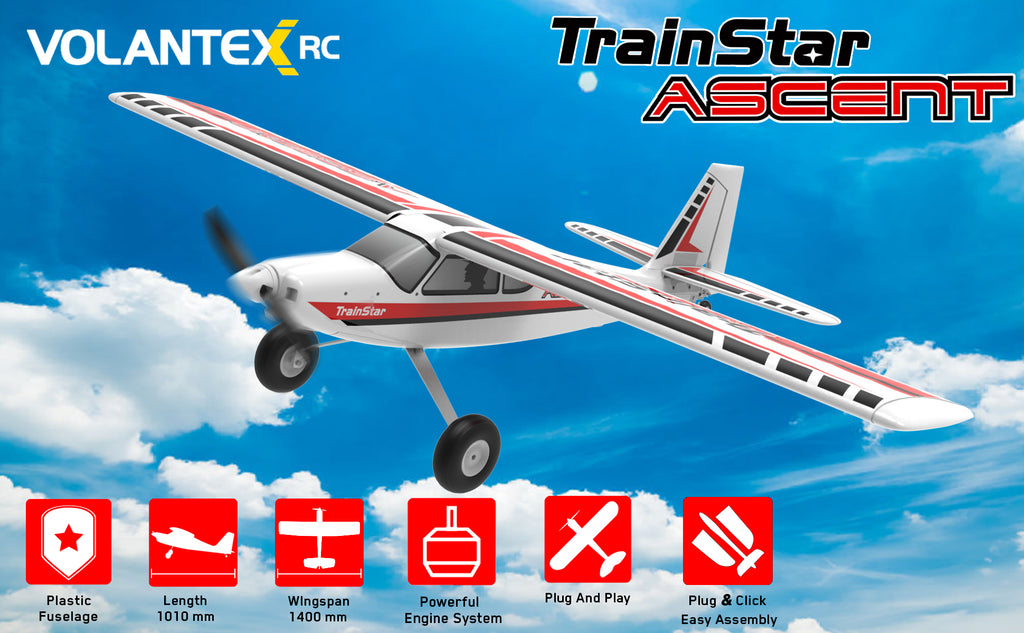
VOLANTEXRC TrainStar ASCENT (PNP) 4CH 1400MM with Over-Grade Power (55.1'') 74708 This brushless trainer requires a high-capacity 3S 11.1V 2200mAh LiPo battery (XT60 plug) to feed its powerful 40A brushless ESC and 4023/1050KV motor.  VOLANTEXRC F-16 Fighting Falcon RC Jet - 40min Flight, Xpilot & Carbon Fiber RTF An RTF model that comes with two compact 3.7V 400mAh LiPo batteries, providing up to 40 minutes of total flight time.
 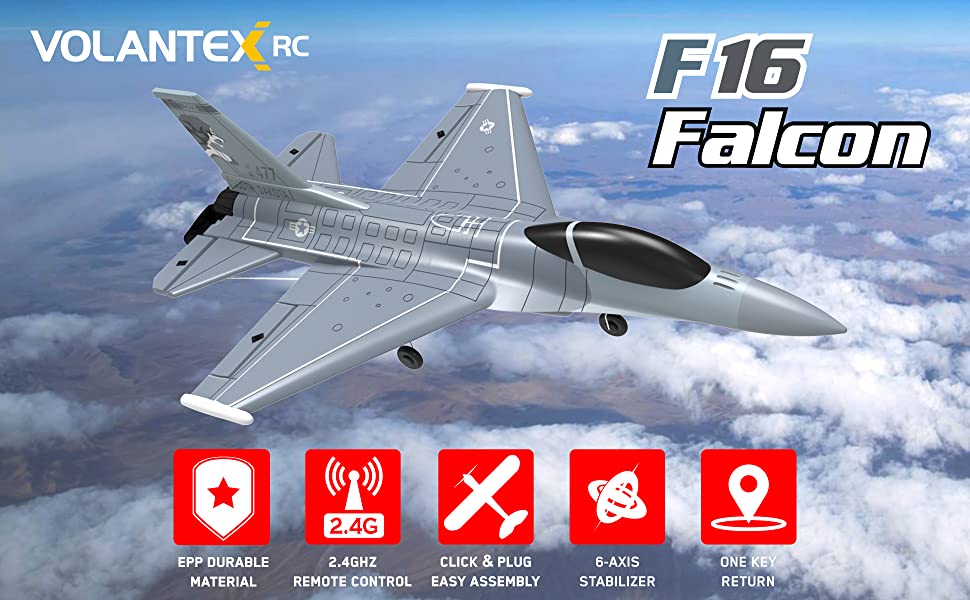 VOLANTEXRC 4CH Jet F16 Fighting Falcon (76110) PNP(No Radio, No Battery included) The Plug-and-Play (PNP) version of the 4CH F-16 jet. It requires pilots to purchase their own 3.7V 400mAh LiPo battery and compatible receiver.
  VOLANTEXRC P-51 Mustang V2 4-CH RC Plane RTF with Xpilot (761-5) Includes two 3.7V 360mAh (or 400mAh) high-efficiency LiPo batteries out of the box, allowing beginners to learn to fly with minimal downtime.
  SUPULSE 2pcs 11.1V 3S 2200mAh 50C Lipo Battery Perfect match for the TrainStar Ascent trainer, providing a strong 50C discharge rate and long flight times.
  2pcs 3.7V 360mAh LiPo Rechargeable Battery for 400mm Series Genuine factory replacement batteries for the VOLANTEXRC 400mm micro plane series, ensuring correct fit and safe CG balance.
  SUPULSE Lipo Safe Bag Fireproof Storage Bag Mandatory storage envelope to ensure safe battery charging, travel, and prevention of thermal runaway hazards.
  SUPULSE B3AC Pro Compact Lipo Balance Charger An easy-to-use plug-and-play compact balance charger that safely balances individual cells for 2S and 3S packs.
---
Practical Battery Selection Checklist for Trainer and Jet Models
To make your battery selection process simple, we have compiled this checklist. When choosing a battery for a new plane, check off each step to ensure a safe, high-performance match.
1. Confirm ESC Voltage Limits
Open the canopy of your plane and inspect the ESC label. Note the maximum cell count (S) it supports. If it reads 2S-3S, your battery search is restricted to 7.4V or 11.1V packs.
2. Measure the Battery Compartment Dimensions
Battery trays are designed with specific physical limits. Measure the length, width, and height of your plane's battery compartment in millimeters. Compare these measurements to the dimensions listed on the battery manufacturer's spec sheet. A battery that does not fit flat on the tray cannot be secured properly, which is highly dangerous.
3. Check the Recommended Flight Weight
Look up the recommended flying weight of your aircraft. The battery should not make up more than 20% to 25% of the plane's total weight. If the pack is heavier, the wing loading will be too high, leading to poor glide characteristics and high stall speeds.
4. Verify the Connector Type
Your battery plug must match the ESC connector. The most common connector types are:
- JST (Red BEC Plug): Used on micro planes and small park flyers drawing under 10 Amps.
- XT30: A compact, high-quality connector for small 2S-3S planes drawing under 30 Amps.
- XT60: The industry standard for medium-sized trainer planes and jets drawing up to 60 Amps. Used on the TrainStar Ascent ESC.
- Deans / T-Plug: A flat, spring-loaded plug used on many classic sport models.
- EC3 / IC3: A blue connector with shrouded pins, common on pre-configured brand models.
If your battery has an XT60 plug but your ESC has a Deans connector, do not use cheap adapter cables. Cut off the ESC connector and solder on a matching XT60 plug. This keeps your wiring clean and eliminates extra resistance.
5. Locate the CG and Plan Placement
Before charging, place your battery inside the compartment and slide it back and forth to find where the plane balances at the recommended CG. Mark this battery position on the tray with a silver sharpie. Use high-quality velcro straps to lock the battery into this exact spot so it cannot slide forward or backward during aggressive loops or rolls.
---
LiPo Safety and Charging: The Rules of the Hobby
Hobbyists also ask: "How do I store and charge my RC plane LiPo batteries safely?"
Always charge LiPo batteries on a dedicated balance charger, store them at a storage charge of 3.80V to 3.85V per cell, and keep them inside a fireproof containment bag. Leaving batteries fully charged for more than 48 hours causes chemical degradation, capacity loss, and swelling.
Lithium Polymer batteries pack an immense amount of energy into a lightweight package. Because they contain volatile organic solvents and highly active lithium compounds, they demand careful handling. One mistake during charging or storage can result in a intense chemical fire. Follow these safety protocols without exception.
The Gold Rules of Safe Charging
- Always Use a Balance Charger: Never charge a LiPo battery using a simple cheap charger that only plugs into the main discharge lead. A balance charger plugs into both the main discharge leads and the white plastic balance plug. It monitors and adjusts the voltage of each individual cell. If one cell rises faster than the others, the charger slows down the current to that cell, preventing it from exceeding 4.2V. Overcharging a single cell beyond 4.3V is the leading cause of LiPo fires. We suggest using a high-quality RC battery charger to keep your packs healthy and balanced.
- Set the Correct Charge Current (C-Rate): We recommend charging your batteries at a 1C rate. To find your 1C charging current in Amps, divide the battery capacity in mAh by 1000. For a 2200mAh battery, a 1C charge rate is 2.2 Amps. For a 360mAh micro pack, the 1C rate is 0.36 Amps (round down to 0.3A or 0.4A on your charger). Charging at higher rates (2C or 3C) is possible on some modern packs, but it degrades cell life and increases the risk of thermal runaway.
- Never Charge Unattended: Always charge your batteries on a non-flammable surface (like concrete or tile) in an area where you can see them. Never leave the house or go to sleep while charger units are running.
- Use a LiPo Safe Bag: Always place your battery packs inside a fireproof containment envelope like the Supulse LiPo Safe Bag during the charging process. If a pack fails, the fireproof fiberglass bag will contain the flames, heat, and toxic smoke, protecting your home.
Storage and Maintenance
LiPo batteries are highly sensitive to the voltage at which they are stored. If you leave a battery fully charged (4.20V per cell) for more than 24 to 48 hours, the lithium compounds inside begin to react with the separator layers. This increases the internal resistance of the cells, causing permanent loss of capacity and power. Storing a battery fully charged is the most common reason packs become puffed and useless.
Conversely, if you store a battery completely drained (under 3.0V per cell), the copper current collectors inside the pack will dissolve into the chemistry, creating a permanent short circuit. The next time you attempt to charge the battery, it will fail and potentially catch fire.
- Storage Voltage: If you do not plan to fly your plane within the next 48 hours, use your balance charger's "Storage" function to bring each cell to 3.80V to 3.85V. This is the chemically most stable state for lithium polymer cells.
- Temperature Control: Store your batteries in a cool, dry place at room temperature (around 65°F to 75°F or 18°C to 24°C). Never leave your battery bags inside a hot car trunk or expose them to direct sunlight at the flying field. High temperatures speed up battery degradation and can trigger thermal runaway.
- Safe Disposal: If a battery puffs, drops below 2.5V per cell, or shows physical damage from a crash, it is time to retire the pack. Do not throw it in the trash. Discharge the battery completely down to 0.0V using a light bulb or a dedicated discharger, cut the connectors, and take it to a local battery recycling center.
---
Technical Specifications and Compatibility Comparison
To help you match the correct battery to your plane, we have compiled this reference table comparing different aircraft categories and their typical battery configurations:
| Aircraft Type | Recommended S-Rating | Typical Capacity (mAh) | Min C-Rating | Example Model Fit |
|---|---|---|---|---|
| Micro Warbirds (400mm) | 1S (3.7V) | 360mAh - 400mAh | 25C | P-51 Mustang RTF, F-16 Falcon RTF |
| Mini Trainer Gliders | 2S (7.4V) | 500mAh - 1000mAh | 30C | Ranger 600S, Sport Cub 500 (modified) |
| Brushless Trainers (1.4m) | 3S (11.1V) | 1300mAh - 2200mAh | 35C | TrainStar Ascent PNP, ASW28 PNP |
| Brushless FPV/Speed Jets | 4S (14.8V) | 1800mAh - 2600mAh | 45C | Phoenix 2400 PNP, F-16 4CH PNP (Upgraded) |
By choosing the right capacity, C-rating, and cell count, you will keep your RC plane stable in the air, achieve maximum flight times, and ensure that your batteries remain safe and healthy for seasons to come. Always prioritize weight balance over flight time, follow charging safety protocols, and enjoy the thrill of stable, confident flight.
---
Frequently Asked Questions
Can I use a higher S-rating battery on my stock trainer plane?
No, that's not a good idea unless you're positive your electronic speed control (ESC) and brushless motor are rated to take that extra voltage. Most stock setups are optimized for a specific cell count, like 2S or 3S. If you plug a 4S battery into a system that's only rated for 3S, you risk immediately burning out the ESC or frying the motor windings from drawing too much current. Always look at the specs printed on your ESC casing before you try stepping up the voltage.
How do I know if my RC plane battery is puffed?
It is pretty easy to spot. A puffed battery will look visibly swollen, and if you press on the sides, it will feel soft and squishy instead of firm and flat. This swelling happens when gas builds up inside the foil packaging, usually from over-discharging the battery, drawing too many amps in flight, or leaving it sitting fully charged for weeks. Once a pack starts to swell, it's a major fire hazard. You should stop using it immediately, discharge it to zero, and safely recycle it.
How do I calculate the max continuous current draw of a battery?
You just need a simple bit of math. First, convert your battery's capacity from milliamp-hours (mAh) to Amp-hours (Ah) by dividing by 1,000. Then, multiply that number by the continuous C-rating printed on the label. For example, if you have a 2,200mAh battery (which is 2.2Ah) rated at 50C, you multiply 2.2 by 50 to get 110 Amps. That tells you your pack can safely deliver up to 110 Amps of continuous current.
What is storage voltage for RC plane LiPo batteries?
The golden number for storage is between 3.80V and 3.85V per cell. If you're not planning to head back to the flying field within the next day or two, you should always use your balance charger to put your packs into storage mode. Leaving them fully charged at 4.20V per cell or leaving them completely drained down below 3.0V per cell will rapidly degrade the battery chemistry, ruining its capacity and cutting its overall life short.


