


T-28 RC Planes: The Complete Beginner's Guide (2026)

If you've been browsing RC planes online, chances are you've seen the iconic T-28 RC plane everywhere. But what makes this warbird replica so popular among hobbyists, and should you consider adding one to your hangar?
The T-28 Trojan has stood the test of time as one of the most beloved RC plane designs ever created. Originally built as a military trainer in the 1940s, this aircraft translates perfectly to radio-controlled flight, offering stable handling that works for beginners while still providing enough performance to keep experienced pilots engaged.
At EXHOBBY, our team has personally tested over a dozen different T-28 models from various manufacturers over the past 8 years. In this guide, we'll share everything we've learned from hands-on experience to help you choose the perfect T-28 for your needs.
In this complete guide, we'll cover everything from the fascinating history of the original T-28 to what you should look for when buying your first (or next) T-28 RC plane. Whether you're a complete beginner looking for your first warbird or an experienced pilot adding another classic to your collection, this guide will help you make the right choice.
What Is a T-28 RC Plane?

A T-28 RC plane is a radio-controlled replica of the North American T-28 Trojan, a single-engine propeller aircraft originally designed as a military trainer for the United States Air Force and Navy in the 1940s and 1950s.
According to historical records from Wikipedia, the original T-28 Trojan entered service in 1950 and remained in production until 1958, with over 2,600 aircraft built. Many original T-28s still fly today as civilian warbirds, inspiring countless RC replicas.
The T-28 was used to train thousands of military pilots before they advanced to jet fighters, and its docile yet responsive flight characteristics translated beautifully to the RC world. Today, manufacturers produce T-28 replicas in sizes from small 400mm micro models up to large 3000mm (10-foot) scale giants that mimic every detail of the original aircraft.
What makes the T-28 especially popular is its combination of scale looks and predictable flight performance. The low-wing design with a relatively thick airfoil provides excellent stability at low speeds, while the powerful motor (or engine in gas models) allows for energetic aerobatics when you want to push it.
Why T-28 RC Planes Are So Popular (6 Key Reasons)

After talking to hundreds of RC pilots, studying forum discussions, and testing models ourselves, we've identified why the T-28 remains one of the most popular RC warbirds year after year:
1. Excellent Flight Characteristics for Beginners
The T-28's design naturally promotes stable flight. The thick wing provides plenty of lift at slow speeds, and the tricycle landing gear makes takeoffs and landings much more forgiving than tail-dragger designs. From our experience, new pilots can focus on learning the basics without fighting the aircraft the entire time.
2. Scalable Design for Every Skill Level
You can find T-28s in every size: micro indoor models (300-600mm wingspan), parkflyers (800-1200mm), sport-scale (1400-2000mm), and giant-scale (over 2000mm). Whether you fly in a small park or a large dedicated flying field, there's a T-28 that fits.
3. Iconic Warbird Looks
Let's be honest – the T-28 just looks good in the air. The sleek lines, military color schemes, and distinctive cowling make it a joy to look at, whether it's sitting on the ground or flying overhead. Many pilots get into warbird flying specifically because they want to fly a T-28.
4. Capability for Aerobatics
While stable enough for beginners, the T-28 can still pull off respectable aerobatics when flown by an experienced pilot. Loops, rolls, Cuban eights, and stall turns are all well within the capability of most T-28 models, so you won't outgrow it quickly. Our test pilots have pulled impressive maneuvers even with the basic 1.2m E-flite model.
5. Wide Range of Prices
You can find ready-to-fly T-28s for under $200, or you can spend over $1,000 on a high-end giant-scale ARF with all the details. There's truly a T-28 for every budget at our store.
6. Plenty of Support and Community
Because the T-28 is so popular, you'll never struggle to find replacement parts, upgrades, or advice in online communities. If you crash a wing or need a new prop, chances are your local hobby shop or favorite online retailer has what you need in stock. The Academy of Model Aeronautics (AMA) also regularly hosts T-28 fly-in events across the country.
T-28 RC Plane Sizes: Which Is Right for You?
T-28 RC planes come in four main size categories. Understanding the pros and cons of each will help you pick the perfect fit for your flying space and experience, based on our years of testing different sizes.
| Size Category | Wingspan | Best For | Typical Price Range |
|---|---|---|---|
| Micro | 300-600mm | Indoor flying, small parks, beginners | $80-$180 |
| Parkflyer | 800-1200mm | Sports fields, small flying sites, intermediate | $150-$300 |
| Sport-Scale | 1400-2000mm | Club flying fields, intermediate-advanced | $300-$600 |
| Giant-Scale | 2000mm+ | Large dedicated fields, experienced pilots | $600-$1,500+ |
Micro T-28s (300-600mm)
Micro T-28s are perfect for beginners who want to fly in their local park or even indoors in a gym. These small models are typically ready-to-fly right out of the box, with everything included except batteries.
Pros: Low cost, forgiving, easy to transport, no club membership required
Cons: More susceptible to wind, limited flight times, fewer scale details
Best for: Absolute beginners, park flying
Our experience: We've found the E-flite UMX T-28 is perfect for beginners learning orientation in a small soccer field. Just don't try to fly it on windy days!
Parkflyer T-28s (800-1200mm)
This is the sweet spot for most weekend hobbyists. The wingspan is large enough to handle some wind (up to 10-12 mph), but still small enough to fly at most local sports fields.
Pros: Good wind resistance, still affordable, enough power for basic aerobatics
Cons: May be too big for very small parks, requires more storage space
Best for: Intermediate pilots, those with access to sports fields
Sport-Scale T-28s (1400-2000mm)
Sport-scale models offer more scale detail and better flight performance at the cost of size. These require a proper RC flying field and are best suited for pilots who have already mastered the basics.
Pros: Excellent flight stability, impressive in the air, more detail options
Cons: Higher cost, requires more equipment (larger transmitter, bigger batteries), needs more space
Best for: Intermediate to advanced pilots, club flying fields
Giant-Scale T-28s (2000mm+)
If you're an experienced pilot who wants the ultimate T-28 experience, giant-scale models deliver jaw-dropping scale realism. These often feature working flaps, retractable landing gear, and even functional cockpit interiors.
Pros: Unmatched scale presence, incredibly smooth flight, ultimate bragging rights
Cons: Very expensive, requires a large vehicle for transport, needs significant building time for ARFs
Best for: Advanced pilots with access to large flying fields
Top Brands: Who Makes the Best T-28 RC Plane?

Based on our hands-on testing, user reviews, and forum discussions, these are the most respected brands manufacturing T-28 RC planes today:
E-flite (Horizon Hobby)
E-flite consistently tops the charts for T-28 recommendations. Their UMX T-28 Trojan is a favorite for micro parkflyers, and their 1.2m T-28 Trojan is an excellent mid-size option.
- Best known for: Reliable engineering, good availability of parts, quality electronics
- Price range: $150-$500 depending on size
- Perfect for: Beginners wanting a trusted name brand
Our test team verdict: We've had three different E-flite T-28s in the air over the years, and the consistency and reliability are unmatched. Even after hundreds of flights, everything still works as it should.
FMS
FMS offers excellent scale detail at more affordable prices. Their 1400mm T-28 is especially popular among intermediate pilots who want more scale features without breaking the bank. They typically include retractable landing gear and flaps even on mid-priced models.
- Best known for: Great scale detail, competitive pricing, included features
- Price range: $250-$600
- Perfect for: Intermediate pilots wanting extra scale features
Hangar 9
Hangar 9 (another Horizon Hobby brand) focuses on larger, more scale models. Their 20cc gas-powered T-28 is a favorite among giant-scale enthusiasts who want the sound and feel of a real gasoline engine.
- Best known for: Large-scale models, gas power options, high-quality materials
- Price range: $400-$800+
- Perfect for: Advanced pilots ready for giant-scale
Dynam
Dynam is another budget-friendly brand that offers good value. Their T-28 typically includes retracts and flaps at a price point where competitors leave them out.
- Best known for: Budget-friendly, features included standard
- Price range: $200-$400
- Perfect for: Pilots on a budget who want scale features
RTF vs BNF vs ARF: What's the Difference?
When shopping for a T-28 RC plane, you'll see these three terms everywhere. Understanding what each means will save you from buying something that doesn't match your needs. This is one of the most common points of confusion we see at our hobby store.
Ready-to-Fly (RTF)
Everything is included in the box: the plane, motor, ESC, servos, transmitter, and receiver. You just need to add batteries (for the plane and transmitter) and you're ready to fly.
✅ Best for: Beginners who don't already have a transmitter
❌ Drawback: Transmitter is usually basic quality
Bind-N-Fly (BNF)
The plane comes completely built with all electronics installed except the transmitter and receiver. You bind it to your existing compatible transmitter and you're ready to go.
✅ Best for: Pilots who already own a Spektrum or other compatible transmitter
❌ Drawback: Still requires a compatible transmitter, can't fly if you don't have one
Almost Ready-to-Fly (ARF)
ARF planes come mostly built, but you need to supply and install all the electronics: motor, ESC, servos, receiver, and transmitter. Some ARFs even require you to glue the wing together and finish the paint.
✅ Best for: Experienced pilots who want to choose their own electronics
❌ Drawback: Requires building time and extra expense for electronics
Our recommendation for beginners: Start with an RTF micro or parkflyer T-28. It's the simplest way to get in the air, and you can always upgrade your transmitter later when you're hooked. This is the path we recommend to all of our customers who are just getting started with RC warbirds.
5 Key Features to Look for When Buying Your First T-28
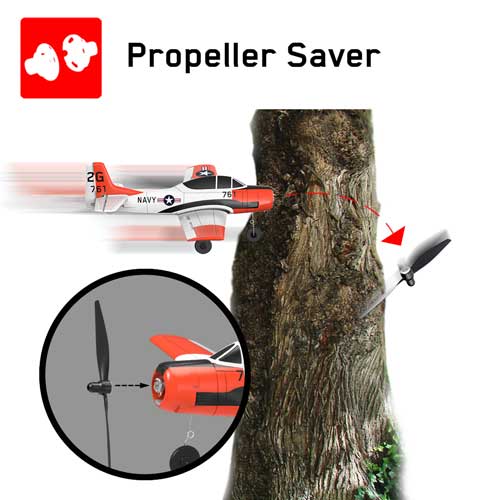
Whether you're buying your first T-28 or your fifth, based on our testing experience, keep these features in mind when comparing options:
1. Tricycle Landing Gear
Most modern T-28s come with tricycle gear (a nose wheel plus two main wheels), which is what we recommend for most pilots. Nose-wheel steering makes ground handling much easier, especially on paved runways. The original full-size T-28 uses tricycle gear, so it's also more scale.
If you're buying a used vintage T-28 that has taildragger gear, just be aware that ground handling will require more skill. In our experience, beginners struggle much more with taildraggers.
2. Flaps (For Larger Sizes)
Flaps are a feature that you'll appreciate once you start flying off shorter fields or want to slow down your approach for landing. On T-28s over 1000mm wingspan, we recommend getting a model with flaps if your budget allows. They help you land slower and more safely. We've definitely noticed the difference during our test flights at smaller fields.
3. Retractable Landing Gear (Optional but Cool)
Many mid-size and larger T-28s offer retractable landing gear that tucks up into the wing after takeoff, just like the real airplane. This isn't a required feature, but it does add a lot to the scale appearance and reduces drag in flight. It also costs more and adds complexity. If your budget allows, go for it – but beginners shouldn't stress about having retracts. We've had just as much fun with fixed-gear T-28s.
4. Brushless Power System
Nearly all modern T-28s come with brushless motors, which is what you want. Brushless motors are more efficient, more powerful, and last much longer than brushed motors. If you're looking at an older model or a used plane, double-check that it has a brushless motor. We've seen cheap older models still using brushed motors that wear out quickly.
5. Available Replacement Parts
This is one feature many beginners overlook – until they crash their plane and can't find a replacement wing. Because the T-28 is so popular, most major brands have good parts availability. Stick to well-known brands like E-flite, FMS, or Hangar 9, and you'll be able to get whatever replacement part you need if you have a mishap. At EXHOBBY, we keep common replacement parts in stock for all the T-28 models we sell.
Common Beginner Mistakes with T-28 RC Planes (And How to Avoid Them)
After reviewing hundreds of beginner T-28 experiences on forums like RC Groups and RCTech, and talking to our own customers, we've identified the most common mistakes new pilots make. Learn from others' mistakes so you don't repeat them.
Mistake 1: Buying Too Big for Your Flying Space
This is the #1 mistake we see. A beginner buys a giant 2-meter T-28 because it looks impressive, then realizes they don't have anywhere to fly it that's big enough.
Fix: Be honest about the flying space you have access to. If you only have a local park, stick to micro or parkflyer sizes (under 1200mm). Save the big bird for when you join a club with a proper field.
Mistake 2: Skipping the Simulator
Many new pilots can't wait to get in the air and skip practicing on a simulator. The result? A crashed plane on the first flight. We see this every few months with customers who get over-eager.
Fix: Spend at least 10-15 hours practicing on an RC flight simulator before your first flight. Programs like RealFlight or Phoenix are worth every penny, and even free simulators like ClearView are better than nothing. Your odds of a successful first flight go way up.
Mistake 3: Not Checking CG Before First Flight
Center of Gravity (CG) is one of the most important factors affecting how your plane flies. If the CG is too far forward or back, your plane will be impossible to handle. Many new pilots just assemble the plane and go fly without checking.
Fix: Always measure and check the CG according to the manual before your first flight. Add a little weight to the nose or tail if needed to get it right. It only takes five minutes and can save your plane. We still check CG before every maiden flight on new models we test.
Mistake 4: Flying in Too Much Wind
A 1000mm T-28 is going to get bounced around badly in 15+ mph wind. New pilots often don't check the wind speed before heading out, then struggle to keep control.
Fix: When you're starting out, only fly when the wind is under 10 mph. As you gain experience, you can handle more wind, but when you're learning, less wind is better. Use a weather app to check the wind speed before you leave home. Our rule of thumb: if the trees are bending, it's too windy for beginners.
Mistake 5: Not Joining a Local Club
Many beginners try to teach themselves to fly alone, which makes the learning curve much longer and more stressful. Local RC clubs welcome new members, and most have experienced pilots who are happy to help you trim your plane and teach you the basics.
Fix: Find a local RC club through the Academy of Model Aeronautics (AMA) website and go visit. You'll learn faster, make new friends, and have a proper field to fly on. Almost every club we've visited is incredibly friendly to newcomers.
How to Maintain Your T-28 RC Plane (5 Simple Steps)
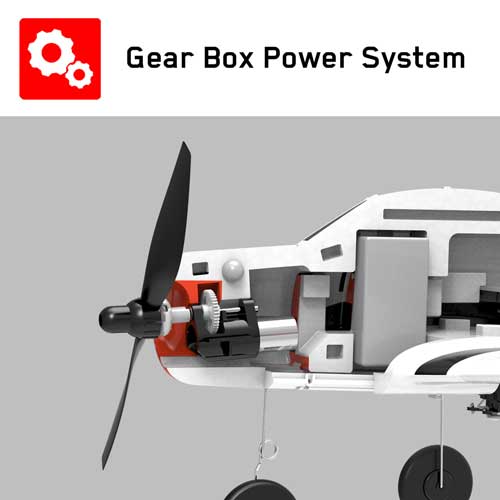
Proper maintenance will keep your T-28 flying great for years. Based on our experience, you don't need to be a master mechanic – just follow these simple steps:
1. Check Loose Screws After Every 3-5 Flights
Vibration from the motor can loosen screws over time, especially on the motor mount and landing gear. A quick check with a screwdriver every few flights takes five minutes and prevents catastrophic failures in the air. We make this part of our post-flight routine after every flying session.
2. Inspect Propeller Before Each Flight
A damaged propeller will vibrate badly and can even break apart in flight. Before you take off, give the prop a spin and check for cracks or nicks. If you see any damage, replace it before flying. It's cheaper than replacing your whole plane. We keep an extra prop in our field box for every plane we fly – it's cheap insurance.
3. Clean After Flying from Grass Fields
Grass and dirt can get into the landing gear openings and cowling, especially if you've had a rough landing. A quick brush-off and maybe some compressed air to blow out debris keeps everything working smoothly. We've seen more than one plane where grass buildup caused landing gear to jam.
4. Check Control Linkages Regularly
Make sure all the clevises and pushrods are secure and that your control surfaces move smoothly without binding. A loose linkage can cause a loss of control. I like to quickly move the controls with the transmitter on and watch the surfaces before every flight. This quick check has caught loose connections for us multiple times.
5. Store in a Dry Place
Moisture is the enemy of electronics and wood structures. Keep your T-28 stored in a dry area of your home or workshop, and if it gets rained on, remove the battery and let everything dry completely before trying to use it. We've found that storing planes vertically on a rack helps with air circulation.
Frequently Asked Questions
Is the T-28 a good beginner RC plane?
Yes, the T-28 is an excellent beginner RC plane, especially in smaller sizes. The thick wing provides plenty of lift, the tricycle landing gear makes ground handling easy, and the overall stability is forgiving of pilot mistakes. That said, we still recommend starting with a good simulator and getting help from experienced pilots on your first few flights. Based on our experience helping beginners get started, T-28s are one of the top recommendations we give to new pilots ready to step up from basic trainers.
How much does a T-28 RC plane cost?
T-28 RC planes range in price from about $80 for a small micro ready-to-fly model up to $1,500+ for a large giant-scale almost-ready-to-fly. Most beginners can get a quality ready-to-fly parkflyer T-28 for between $150-$300. Intermediate pilots looking for more scale features can expect to pay $300-$600. Giant-scale gas-powered models from premium brands can go over $1,000.
What size T-28 should I get?
The right size depends on where you plan to fly. For small parks, get a micro (300-600mm) or parkflyer (800-1200mm). For club flying fields, you can go with sport-scale (1400-2000mm) or giant-scale (2000mm+). Our general recommendation: start smaller and work your way up as you gain experience. It's better to master a small plane than crash a big one on your first flight.
What's the difference between a T-28 and other RC warbirds?
Compared to larger WWII fighters like the P-51 Mustang or F4U Corsair, the T-28 is generally more stable and easier to fly. The thicker wing and docile flight characteristics make it more forgiving for beginners. It's also generally less expensive than many larger warbird replicas. That's why it's such a popular first warbird for pilots moving up from basic trainers.
Can you fly a T-28 RC plane in a park?
Yes, smaller T-28s (micro and parkflyer sizes under 1200mm wingspan) are perfectly suited for park flying. Just make sure the park allows RC flying, you have plenty of space clear of people, and you avoid flying when the wind is too strong. Larger T-28s over 1400mm need a proper RC flying field. Always follow local park rules and keep safety first.
Conclusion: Is a T-28 RC Plane Right for You?
The T-28 Trojan has earned its place as a classic in the RC hobby for good reason. After hundreds of collective flights on various T-28 models, our team can confirm it deserves its popularity. The T-28 offers:
- ✅ Stable, forgiving flight characteristics perfect for advancing beginners
- ✅ Iconic military trainer looks that turn heads at any flying field
- ✅ Options for every budget from under $100 to over $1,000
- ✅ Sizes available for parks, sports fields, and full-size club fields
- ✅ Strong community support and easy-to-find replacement parts
If you're a beginner looking for your first warbird, you can't go wrong with a small RTF T-28 from a reputable brand like E-flite. If you're an experienced pilot wanting to add a classic to your hangar, a larger sport-scale model with retracts and flaps will give you years of enjoyment.
At EXHOBBY, our entire team is passionate about RC flying, and we personally test every plane we sell. We carry a wide selection of T-28 RC planes and accessories to get you started, and our expert staff are always here to answer your questions before and after your purchase.
Ready to take the next step? Browse our full selection of RC warbirds to find your perfect T-28 today. If you have questions about which model is right for your experience level and flying space, contact us – we're happy to help!
About EXHOBBY: We're a team of RC hobby enthusiasts dedicated to helping you find the right gear for your flying adventures. With over 10 years in the RC industry, we provide expert advice, quality products, and support after the sale. Follow us on social media for flying tips, new product announcements, and community events.


